BSc (Hons) Airline & Airport Management
About University of West London
 The University of West London is located in the heart of one of the UK’s most successful business regions, with strong connections to many national and multinational organisations.
The University draws on its heritage of over 150 years in teaching and professional education. From the outset, the University has played, and continues to play, a significant role in the educational, cultural, and economic life of its region. Over the years, leading academic institutions, career-specific training providers, and industry specialists have come together to make us what we are today – a university dedicated to your career.
The University of West London pride themselves on delivering career-focused courses with excellent teaching in a campus designed for a great student experience.
- University of the Year for Student Experience and University of the Year for Teaching Quality in The Times and Sunday Times Good University Guide 2023.
- Number 32 out of 121 universities nationwide in The Guardian University Guide 2024.
- Ranked 1st in London, 3rd in England and 4th in the UK in the National Student Survey 2023*.
- University of the Year for Social Inclusion in the Daily Mail University Guide 2024.
- Employability – Our career-focused courses will allow to immerse yourself in your chosen career before you even graduate.
- Diversity – We have one of the most diverse student populations in the country.
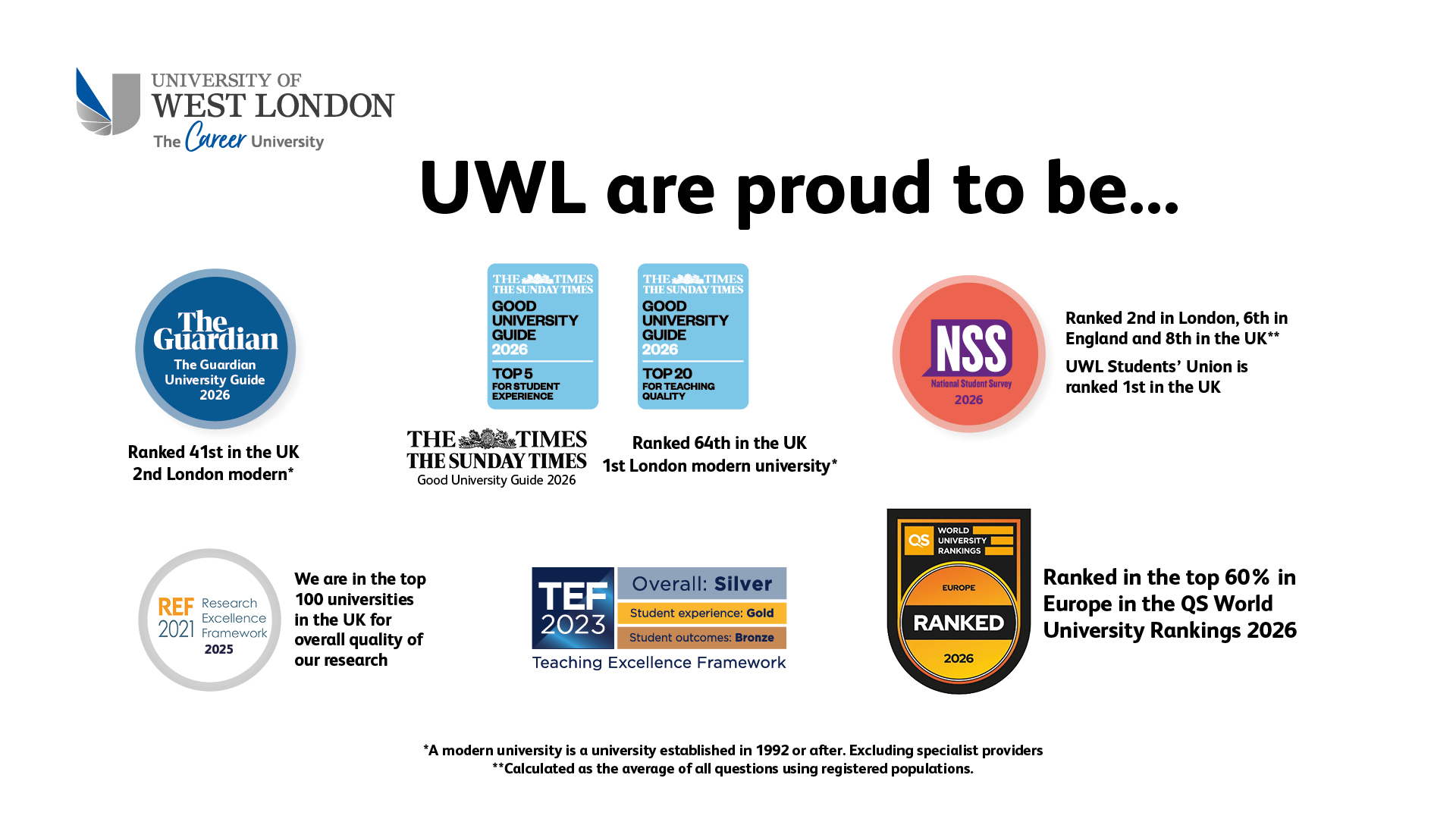
Reference to https://www.uwl.ac.uk/about-us/our-facts-and-achievements
COURSE OVERVIEW

Course Objectives
LEVEL 4
Level 4 is intended to develop the student’s knowledge of the air transport industry and the key issues, trends and developments facing it. The emphasis is on developing skills and delivering the broad topic areas of the industry. The six core modules studied at level 4 are designed to provide a sound platform of learning to support the higher levels of the programme and to stimulate and maintain the student’s interest in aviation. All the modules develop the student’s understanding and knowledge of the industry, its different sectors, the major players and the current issues facing each sector, thus providing essential knowledge and understanding as they commence their initial modules.
The modules provide a thorough understanding of the history, development and attributes of the aviation industry. The subject-specific themes of service provision and management are also covered so that these topics can be developed at later levels. To enable management students to develop confidence in analytics and technology, a gentle introduction to the physics of flight and financial calculations is introduced so that further numerical skills can be developed at later levels. A key element of the early part of the course is to instil professional values in students so that they can develop confidence in building professional relationships and networks with their peers both in academia and in industry. This incorporates developing soft skills required by the industry and their own personal employability skills so that they can better market themselves as future leaders.
LEVEL 5
Level 5 builds on the learning and skills acquisition in level 4 and introduces the student to some more complex and challenging issues facing aviation management. The emphasis at this level is to develop an in-depth understanding of the operational processes and systems of the industry. At the heart of delivering a safe and efficient service is the management and development of people.
This is broadly covered by multiple modules though formally covered within the Talent Management and Leadership module. For placement students, in particular, the content is tailored to developing service provision and management skills prior to commencing their experience in the industry year. The aim of the course at this level is also to introduce students to research methods within both academia and industry so that students can build on this at Level 6 during the dissertation module and also explore the processes of business research and insight if on the placement route.
LEVEL 6
Level 6 is aimed to further develop the student into a confident, open-minded and innovative leader, taking a more strategic approach to the aviation industry and exploring current and future trends. Their individual academic development to graduate level is aided through their dissertation/business project, a substantial piece of research-based work that builds on the skills and knowledge attained in the Applied Research Methods module at Level 5. A key element of level 6 is for students to develop skills in independent thinking, planning and decision making. Students are encouraged to reflect on the progress at previous levels identifying areas of strength and weakness.
In part, this develops students to take on further training and study at the postgraduate level. In preparation for graduate employment, modules at this stage of the course enable authentic assessments, critical analysis and evaluation. Many of the air transport industry’s contemporary issues are covered so that students can be more confident when communicating with potential employers and other industry leaders. Skills development is increasingly recognised as making a significant contribution to the careers of graduates in terms of the achievement of their full educational potential and adding value to their lifelong learning through preparing them for employment and/or career progression.
The Library has a strong commitment to teaching information literacy skills and the encouragement and development of truly independent learners and is increasingly embedding information skills teaching within the curriculum. Online learning objects allow students to independently learn and practice their information skills and test their progress. Throughout the degree, students will be expected to exercise initiative and take responsibility for their learning. This, for example, is reflected in their ability to work to deadlines. A range of transferable skills and competencies such as oral and written communication are developed across and between levels and in doing so provide a foundation for life-long learning. Successful completion of the course is an indication of competence as an academic practitioner and a student’s ability to confirm/repudiate and apply existing theory and knowledge in the chosen field.