COURSE OVERVIEW
Take Your Aviation Career to New Heights


| Minimum Age | 18 Year Old |
| Language Proficiency |
|
| Normal Entry |
|
| Alternative Entry | Applicants with the minimum age of 30, who do not possess the above qualifications but have a minimum of 8 years working experience, may be considered for entry on to this course. Evidence of previous employment will need to be provided as well as a reference from the current/most recent employer (on letter-headed paper). |
| Awarding Body | SISH Institute |
| Diploma Awarded | Higher Diploma in Aviation Management |
| Mode Of Delivery | The method of teaching consists of multiple delivery dimensions like classroom lectures, group discussions, work-based case studies, problem-solving and group activities |
| Graduation Requirements | Obtained a passing mark in all modules |
| Progression Pathway | Upon graduation from the SISH Higher Diploma in Aviation Management, students may progress to take up the following programme subjected to university approval: |
| Course Duration |
|
| Next Available Intake(s) | January, May, September |
This module aims to impart students a life-long self-learning process approach in academic production skills to prepare them for higher education. The students will learn and apply key academic skills on presentation and research finding writing in the academic contexts on class assignments, projects and examinations. In addition, the module introduces students to professional development skills that will increase their employability profile. Students will learn effective communication skills and proper etiquette in the workplace.
The module has been designed to provide general knowledge of the international aviation industry. It prepares students with the prerequisite knowledge of the aviation industry and its key industry stakeholders before joining the industry. Students will learn the regulatory environment of the airline industry, as well as the airport business and its economic impact. The module will also examine the inter-relationship amongst the organisations within the industry and how regulatory bodies, trade associations and ancillary organisations support this to form an aviation system that is safe, secure and seamless for users.
The module has been designed to provide a basic overview of the principles of flight and operation of commercial aircraft, and the effects of these characteristics on the acceptance of cargo. The module is also designed to introduce students to the principles of airline scheduling and equipment maintenance.
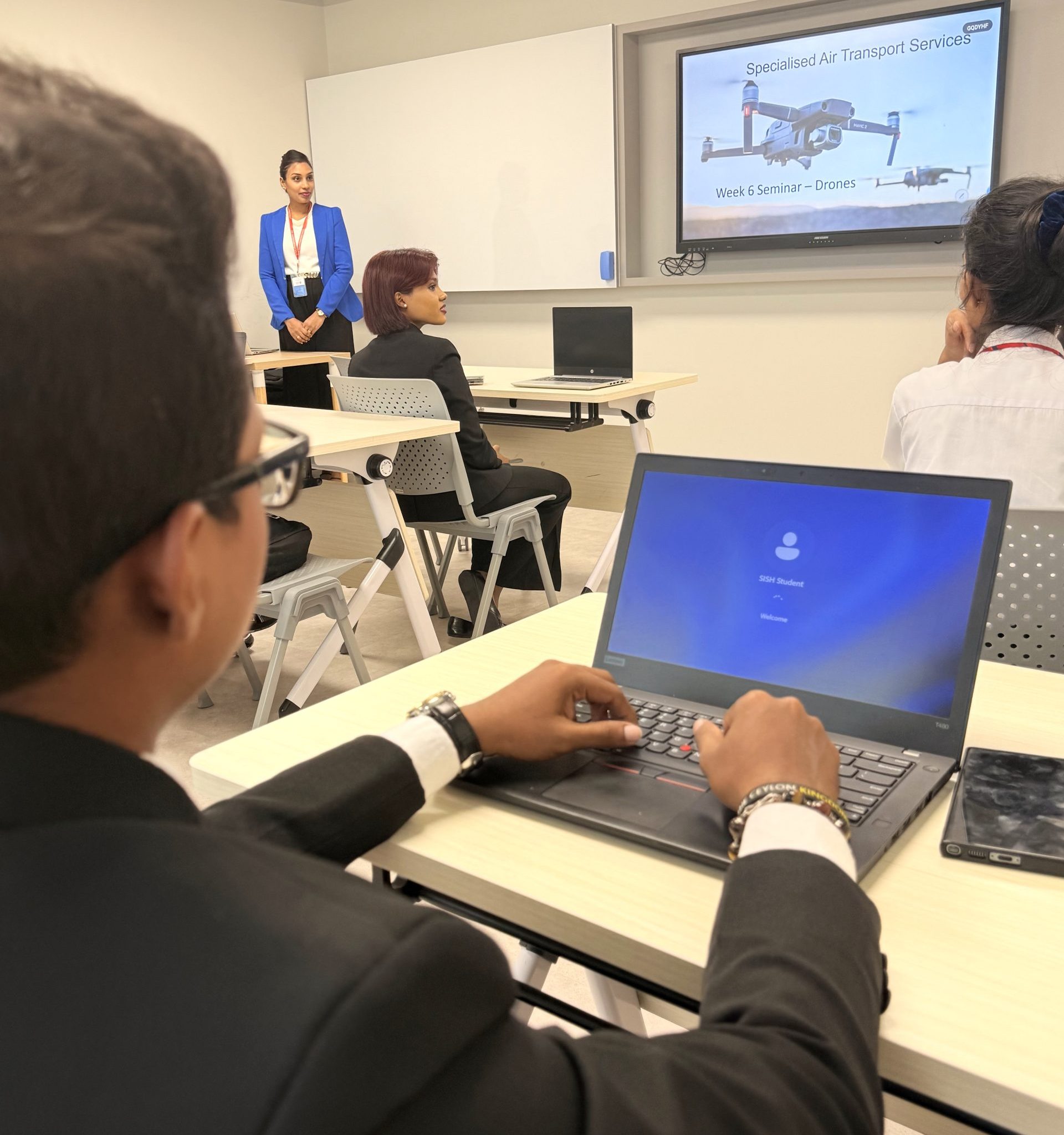
The module focuses on introducing the structure, nature and operating characteristics of the segments of aviation that are outside of the mainstream of civil passenger aviation industry. These specialised air aviation transport services segment includes, but are not limited to, Business and Corporate Aviation, Cargo Airlines, Unmanned Air Systems, Air Ships, Law Enforcement, AirAmbulance and Military. The module is designed to equip students with the knowledge of the key developments and components that have helped shape those parts of the international aviation industry.
This module is designed to provide an introduction into the various aspect of aviation financial analysis to develop students’ numerical ad analytical skills that they are likely to encounter in their working lives.Students will be imparted with the challenges that businesses face in relation to raising sources of finance and learn to interpret and diagnose the accounting and financial information for business decision making.